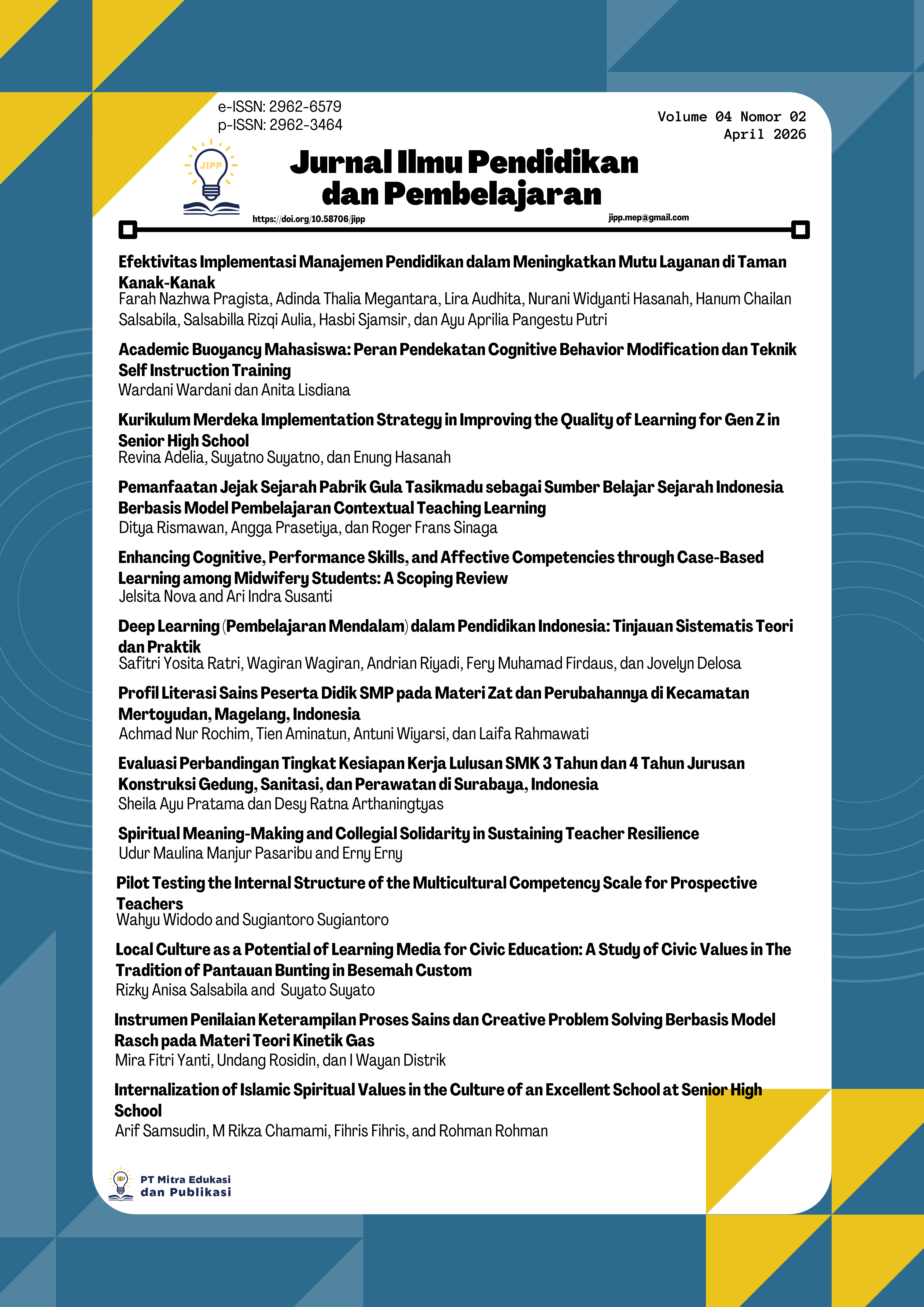
Academic Buoyancy Mahasiswa: Peran Pendekatan Cognitive Behavior Modification dan Teknik Self Instruction Training
DOI:
https://doi.org/10.58706/jipp.v8n1.p123-135Keywords:
Academic Buoyancy, Cognitive Behavior Modification, Self Instruction Training, MahasiswaAbstract
Permasalahan academic buoyancy atau kemampuan mahasiswa dalam menghadapi tekanan akademik sehari-hari menjadi tantangan yang semakin nyata di lingkungan perguruan tinggi. Penelitian ini bertujuan untuk merancang dan menguji efektivitas pendekatan cognitive behavior modification (CBM) yang dipadukan dengan teknik self-instruction training dalam mengembangkan academic buoyancy mahasiswa. Pendekatan penelitian yang digunakan adalah mix methods dengan strategi embedded concurrent, yaitu pengumpulan data kualitatif dan kuantitatif secara bersamaan dalam satu tahap. Populasi penelitian terdiri dari 1.615 mahasiswa, dan sampel diambil sebanyak 321 responden menggunakan rumus Slovin dengan toleransi kesalahan 5% dan teknik proportional random sampling. Subjek berasal dari Jurusan Pendidikan IPS Universitas Lampung (274 mahasiswa) dan Program Studi Pendidikan IPS IAIN Metro (47 mahasiswa). Hasil penelitian menunjukkan bahwa penerapan teknik self-instruction training dalam pendekatan CBM secara konsisten mampu meningkatkan aspek kognitif dan afektif dalam academic buoyancy mahasiswa. Kesimpulan dari penelitian ini adalah bahwa intervensi psikopedagogis berbasis CBM efektif dalam membantu mahasiswa mengelola tekanan akademik secara adaptif. Temuan ini memberikan implikasi penting bagi institusi pendidikan tinggi untuk mengintegrasikan program penguatan academic buoyancy dalam layanan bimbingan dan pengembangan karakter mahasiswa.
References
af Ursin, P., Järvinen, T., & Pihlaja, P. (2021). The role of academic buoyancy and social support in mediating associations between academic stress and school engagement in Finnish primary school children. Scandinavian Journal of Educational Research, 65(4), 661-675. DOI: https://doi.org/10.1080/00313831.2020.1739135.
Alhadabi, A. & Karpinski, A.C. (2020). Grit, self-efficacy, achievement orientation goals, and academic performance in University students. International Journal of Adolescence and Youth, 25(1), 519-535. DOI: https://doi.org/10.1080/02673843.2019.1679202.
Alyahyan, E. & Düştegör, D. (2020). Predicting academic success in higher education: literature review and best practices. International Journal of Educational Technology in Higher Education, 17, 1-21. DOI: https://doi.org/10.1186/s41239-020-0177-7.
Anderson, R.C., Beach, P.T., Jacovidis, M., & Chadwick, K.L. (2020). Academic buoyancy and resilience for diverse students around the world. London: Inflexion. Retrieved from: https://www.ibo.org/globalassets/new-structure/research/pdfs/academic-resilience-policy-paper-en.pdf.
Aydın, G. & Michou, A. (2020). Self‐determined motivation and academic buoyancy as predictors of achievement in normative settings. British Journal of Educational Psychology, 90(4), 964-980. DOI: https://doi.org/10.1111/bjep.12338.
Colmar, S., Liem, G.A.D., Connor, J., & Martin, A.J. (2019). Exploring the relationships between academic buoyancy, academic self-concept, and academic performance: a study of mathematics and reading among primary school students. Educational Psychology, 39(8), 1068-1089. DOI: https://doi.org/10.1080/01443410.2019.1617409.
Cucchi, A. (2022). Integrating cognitive behavioural and Islamic principles in psychology and psychotherapy: a narrative review. Journal of Religion and Health, 61(6), 4849-4870. DOI: https://doi.org/10.1007/s10943-022-01576-8.
Datu, J.A.D., & Yang, W. (2021). Academic buoyancy, academic motivation, and academic achievement among filipino high school students. Current Psychology, 40, 3958-3965. DOI: https://doi.org/10.1007/s12144-019-00358-y.
Dignath, C. & Veenman, M.V. (2021). The role of direct strategy instruction and indirect activation of self-regulated learning—Evidence from classroom observation studies. Educational Psychology Review, 33(2), 489-533. DOI: https://doi.org/10.1007/s10648-020-09534-0.
Driscoll, M.P. & Burner, K.J. (2024). Psychological foundations of instructional design. In R.A. Reiser, A.A. Carr-Chellman, J.V. Demmpsey (Eds) Trends and issues in instructional design and technology (5th ed, pp. 85-98). New York: Routledge. DOI: https://doi.org/10.4324/9781003502302.
Gazki, P.R., Delavar, A., & Samavi, A. (2019). Does academic commitment affect the learners' progress through academic buoyancy? A structural equation model. Iranian Evolutionary and Educational Psychology Journal, 1(3), 196-203. DOI: https://doi.org/10.29252/ieepj.1.3.196.
Granziera, H., Liem, G.A.D., Chong, W.H., Martin, A.J., Collie, R.J., Bishop, M., & Tynan, L. (2022). The role of teachers' instrumental and emotional support in students' academic buoyancy, engagement, and academic skills: A study of high school and elementary school students in different national contexts. Learning and Instruction, 80, 101619. DOI: https://doi.org/10.1016/j.learninstruc.2022.101619.
Hedman-Lagerlöf, E., Carlbring, P., Svärdman, F., Riper, H., Cuijpers, P., & Andersson, G. (2023). Therapist‐supported Internet‐based cognitive behaviour therapy yields similar effects as face-to-face therapy for psychiatric and somatic disorders: an updated systematic review and meta-analysis. World Psychiatry, 22(2), 305-314. DOI: https://doi.org/10.1002/wps.21088.
Hensley, L.C., Iaconelli, R., & Wolters, C.A. (2022). “This weird time we’re in”: How a sudden change to remote education impacted college students’ self-regulated learning. Journal of Research on Technology in Education, 54(sup1), S203-S218. DOI: https://doi.org/10.1080/15391523.2021.1916414.
Hertenstein, E., Trinca, E., Wunderlin, M., Schneider, C. L., Züst, M. A., Fehér, K. D., Su, T., Straten, C.L., Berger, T., Baglioni, C., Johann, A., Spiegelhalder, K., Riemann, D., Feige, B., & Nissen, C. (2022). Cognitive behavioral therapy for insomnia in patients with mental disorders and comorbid insomnia: A systematic review and meta-analysis. Sleep Medicine Reviews, 62, 101597. DOI: https://doi.org/10.1016/j.smrv.2022.101597.
Hirvonen, R., Putwain, D.W., Määttä, S., Ahonen, T., & Kiuru, N. (2020). The role of academic buoyancy and emotions in students’ learning-related expectations and behaviours in primary school. British Journal of Educational Psychology, 90(4), 948-963. DOI: https://doi.org/10.1111/bjep.12336.
Hirvonen, R., Yli-Kivistö, L., Putwain, D.W., Ahonen, T., & Kiuru, N. (2019). School-related stress among sixth-grade students–Associations with academic buoyancy and temperament. Learning and Individual Differences, 70, 100-108. DOI: https://doi.org/10.1016/j.lindif.2019.01.012.
Hoferichter, F., Hirvonen, R., & Kiuru, N. (2021). The development of school well-being in secondary school: High academic buoyancy and supportive class-and school climate as buffers. Learning and Instruction, 71, 101377. DOI: https://doi.org/10.1016/j.learninstruc.2020.101377.
Huang, S. (2022). A review of the relationship between EFL teachers’ academic buoyancy, ambiguity tolerance, and hopelessness. Frontiers in Psychology, 13, 831258. DOI: https://doi.org/10.3389/fpsyg.2022.831258.
Huerta-Cervantes, M., Peña-Montes, D.J., López-Vázquez, M.Á., Montoya-Pérez, R., Cortés-Rojo, C., Olvera-Cortés, M.E., & Saavedra-Molina, A. (2021). Effects of gestational diabetes in cognitive behavior, oxidative stress and metabolism on the second-generation off-spring of rats. Nutrients, 13(5), 1575. DOI: https://doi.org/10.3390/nu13051575.
Jahedizadeh, S., Ghonsooly, B., & Ghanizadeh, A. (2019). Academic buoyancy in higher education: Developing sustainability in language learning through encouraging buoyant EFL students. Journal of Applied Research in Higher Education, 11(2), 162-177. DOI: https://doi.org/10.1108/jarhe-04-2018-0067.
Jang, S., Kim, J.-J., Kim, S.-J., Hong, J., Kim, S., & Kim, E.J. (2021). Mobile app-based chatbot to deliver cognitive behavioral therapy and psychoeducation for adults with attention deficit: A development and feasibility/usability study. International Journal of Medical Informatics, 150, 104440. DOI: https://doi.org/10.1016/j.ijmedinf.2021.104440.
Karyotaki, E., Efthimiou, O., Miguel, C., Bermpohl, F.M.G., Furukawa, TA., Cuijpers, P., & Individual Patient Data Meta-Analyses for Depression (IPDMA-DE) Collaboration. (2021). Internet-based cognitive behavioral therapy for depression: a systematic review and individual patient data network meta-analysis. JAMA Psychiatry, 78(4), 361-371. DOI: https://doi.org/10.1001/jamapsychiatry.2020.4364.
Keefer, L., Ballou, S.K., Drossman, D.A., Ringstrom, G., Elsenbruch, S., & Ljótsson, B. (2022). A Rome working team report on brain-gut behavior therapies for disorders of gut-brain interaction. Gastroenterology, 162(1), 300-315. DOI: https://doi.org/10.1053/j.gastro.2021.09.015.
Khalaf, M.A. & Abulela, M.A. (2021). The academic buoyancy scale: Measurement invariance across culture and gender in Egyptian and Omani undergraduates. European Journal of Educational Research, 10(4), 2121-2131. DOI: https://doi.org/10.12973/eu-jer.10.4.2121.
Kim, H.J., Hong, A.J., & Song, H.-D. (2019). The roles of academic engagement and digital readiness in students’ achievements in university e-learning environments. International Journal of Educational Technology in Higher Education, 16(1), 1-18. DOI: https://doi.org/10.1186/s41239-019-0152-3.
Lawrence, J. (2001). Academics and first-year students: collaborating to access success in an unfamiliar university culture. Widening Participation and Lifelong Learning, 3(3), 4-14. Retrieved from: https://www.ingentaconnect.com/content/openu/jwpll/2001/00000003/00000003/art00002.
Lei, W., Wang, X., Dai, D. Y., Guo, X., Xiang, S., & Hu, W. (2022). Academic self-efficacy and academic performance among high school students: A moderated mediation model of academic buoyancy and social support. Psychology in the Schools, 59(5), 885-899. DOI: https://doi.org/10.1002/pits.22653.
Leon, J.A. & Pepe, H. J. (1983). Self-instructional training: CBM for remediating arithmetic deficits. Exceptional Children, 50(1), 54-60. DOI: https://doi.org/10.1177/001440298305000107.
Liu, C.-y., Zhao, Y.-n., Wang, X.-q., Qin, S., Wan, Q.-y., Zheng, S.-y., & Wu, W.-z. (2022). Acupuncture combined with traditional Chinese medicine e-aid cognitive behavioral therapy for insomnia (TCM-eCBT-I) for chronic insomnia: study protocol for a randomized controlled trial. Trials, 23(1), 86. DOI: https://doi.org/10.1186/s13063-022-06012-6.
Liu, H., Peng, H., Song, X., Xu, C., & Zhang, M. (2022). Using AI chatbots to provide self-help depression interventions for university students: A randomized trial of effectiveness. Internet Interventions, 27, 100495. DOI: https://doi.org/10.1016/j.invent.2022.100495.
Liu, Z., Qiao, D., Xu, Y., Zhao, W., Yang, Y., Wen, D., Li, X., Nie, X., Dong, Y., Tang, S., Jiang, Y., Wang, Y., Zhao, J., & Xu, Y. (2021). The efficacy of computerized cognitive behavioral therapy for depressive and anxiety symptoms in patients with COVID-19: randomized controlled trial. Journal of Medical Internet Research, 23(5), e26883. DOI: https://doi.org/10.2196/26883.
Luttenberger, K., Karg-Hefner, N., Berking, M., Kind, L., Weiss, M., Kornhuber, J., & Dorscht, L. (2022). Bouldering psychotherapy is not inferior to cognitive behavioural therapy in the group treatment of depression: A randomized controlled trial. British Journal of Clinical Psychology, 61(2), 465-493. DOI: https://doi.org/10.1111/bjc.12347.
Martin, A.J. & Marsh, H. W. (2020). Investigating the reciprocal relations between academic buoyancy and academic adversity: Evidence for the protective role of academic buoyancy in reducing academic adversity over time. International Journal of Behavioral Development, 44(4), 301-312. DOI: https://doi.org/10.1177/0165025419885027.
Martin, A.J. & Marsh, H.W. (2009). Academic resilience and academic buoyancy: Multidimensional and hierarchical conceptual framing of causes, correlates and cognate constructs. Oxford Review of Education, 35(3), 353-370. DOI: https://doi.org/10.1080/03054980902934639.
McCabe, J.M. (2016). Connecting in college: How friendship networks matter for academic and social success. Chicago: University of Chicago Press. DOI: https://doi.org/10.7208/chicago/9780226409665.001.0001.
Mishra, S. (2020). Social networks, social capital, social support and academic success in higher education: A systematic review with a special focus on ‘underrepresented’ students. Educational Research Review, 29, 100307. DOI: https://doi.org/10.1016/j.edurev.2019.100307.
Nurjamin, A., Salazar-Espinoza, D.-E., Saenko, N., & Bina, E. (2023). Learner-oriented assessment matters: testing the effects of academic buoyancy, reflective thinking, and learner enjoyment in self-assessment and test-taking anxiety management of the EFL learners. Language Testing in Asia, 13(1), 30. DOI: https://doi.org/10.1186/s40468-023-00247-z.
Putwain, D.W., Gallard, D., & Beaumont, J. (2020). Academic buoyancy protects achievement against minor academic adversities. Learning and Individual Differences, 83, 101936. DOI: https://doi.org/10.1016/j.lindif.2020.101936.
Putwain, D.W., Wood, P., & Pekrun, R. (2020). Achievement emotions and academic achievement: Reciprocal relations and the moderating influence of academic buoyancy. Journal of Educational Psychology, 114(1), 108-126. DOI: https://doi.org/10.1037/edu0000637.
Radhamani, R., Kumar, D., Nizar, N., Achuthan, K., Nair, B., & Diwakar, S. (2021). What virtual laboratory usage tells us about laboratory skill education pre-and post-COVID-19: Focus on usage, behavior, intention and adoption. Education and Information Technologies, 26(6), 7477-7495. DOI: https://doi.org/10.1007/s10639-021-10583-3.
Reid, J.E., Laws, K.R., Drummond, L., Vismara, M., Grancini, B., Mpavaenda, D., & Fineberg, N.A. (2021). Cognitive behavioural therapy with exposure and response prevention in the treatment of obsessive-compulsive disorder: A systematic review and meta-analysis of randomised controlled trials, Comprehensive Psychiatry, 106, 152223. DOI: https://doi.org/10.1016/j.comppsych.2021.152223.
Riggs, M., Franklin, R., & Saylany, L. (2019). Associations between cardiopulmonary resuscitation (CPR) knowledge, self-efficacy, training history and willingness to perform CPR and CPR psychomotor skills: a systematic review. Resuscitation, 138, 259-272. DOI: https://doi.org/10.1016/j.resuscitation.2019.03.019.
Safa, J.S., Esfhani, M.D., & Poordel, M. (2021). Development of a model of academic buoyancy based on with school connection, Family’s emotional atmoshphere, motivation, self-efficacy and academic engagement of students. Journal of Counseling Research, 20(77), 6249. DOI: https://doi.org/10.18502/qjcr.v20i77.6149.
Sangsawang, T. (2020). An instructional design for online learning in vocational education according to a self-regulated learning framework for problem solving during the COVID-19 crisis. Indonesian Journal of Science and Technology, 5(2), 283-298. DOI: https://doi.org/10.17509/ijost.v5i2.24702.
Schneider, K.R., Nair, U., Straney, R., Lancey, P., & Tripp, M. (2021). First-year STEM research program facilitates long-term academic success. Journal of College Science Teaching, 50(4), 11-16. DOI: https://doi.org/10.1080/0047231x.2021.12290513.
Schwartz, B., Cohen, Z. D., Rubel, J. A., Zimmermann, D., Wittmann, W. W., & Lutz, W. (2021). Personalized treatment selection in routine care: Integrating machine learning and statistical algorithms to recommend cognitive behavioral or psychodynamic therapy. Psychotherapy Research, 31(1), 33-51. DOI: https://doi.org/10.1080/10503307.2020.1769219.
Specialists, E. & Kolb, L. (2021). An effective model of diabetes care and education: the ADCES7 Self-Care Behaviors™. The Science of Diabetes Self-Management and Care, 47(1), 30-53. DOI: https://doi.org/10.1177/0145721720978154.
Stadtfeld, C., Vörös, A., Elmer, T., Boda, Z., & Raabe, I. J. (2019). Integration in emerging social networks explains academic failure and success. Proceedings of the National Academy of Sciences, 116(3), 792-797. DOI: https://doi.org/10.1073/pnas.1811388115.
Stallard, P. (2022). Evidence-based practice in cognitive–behavioural therapy. Archives of Disease in Childhood, 107(2), 109-113. DOI: https://doi.org/10.1136/archdischild-2020-321249.
Theobald, M. (2021). Self-regulated learning training programs enhance university students’ academic performance, self-regulated learning strategies, and motivation: A meta-analysis. Contemporary Educational Psychology, 66, 101976. DOI: https://doi.org/10.1016/j.cedpsych.2021.101976.
Thomas, C.L. & Allen, K. (2021). Driving engagement: Investigating the influence of emotional intelligence and academic buoyancy on student engagement. Journal of Further and Higher Education, 45(1), 107-119. DOI: https://doi.org/10.1080/0309877x.2020.1741520.
Wang, Y., Kordi, Y., Mishra, S., Liu, A., Smith, N.A., Khashabi, D., & Hajishirzi, H. (2022). Self-instruct: Aligning language model with self-generated instructions. arXiv. DOI: https://doi.org/10.18653/v1/2023.acl-long.754.
Wergeland, G.J., Ghaderi, A., Fjermestad, K., Enebrink, P., Halsaa, L., Njardvik, U., Riise, E.N., Vorren, G., & Öst, L.-G. (2025). Family therapy and cognitive behavior therapy for eating disorders in children and adolescents in routine clinical care: a systematic review and meta-analysis. European Child & Adolescent Psychiatry, 34(3), 883-902. DOI: https://doi.org/10.1007/s00787-024-02544-1.
Yang, S., Noughabi, M.A., & Jahedizadeh, S. (2022). Modelling the contribution of English language learners’ academic buoyancy and self-efficacy to L2 grit: evidence from Iran and China. Journal of Multilingual and Multicultural Development, 45(7), 2701-2717. DOI: https://doi.org/10.1080/01434632.2022.2062368.
Yitmen, I., Alizadehsalehi, S., Akıner, İ., & Akıner, M.E. (2021). An adapted model of cognitive digital twins for building lifecycle management. Applied Sciences, 11(9), 4276. DOI: https://doi.org/10.3390/app11094276.
Zhang, M. (2021). EFL/ESL teacher’s resilience, academic buoyancy, care, and their impact on students’ engagement: A theoretical review. Frontiers in Psychology, 12, 731859. DOI: https://doi.org/10.3389/fpsyg.2021.731859.
Downloads
Statistics
Additional Files
Published
How to Cite
Issue
Section
License
Copyright (c) 2026 Wardani Wardani, Anita Lisdiana

This work is licensed under a Creative Commons Attribution-NonCommercial 4.0 International License.