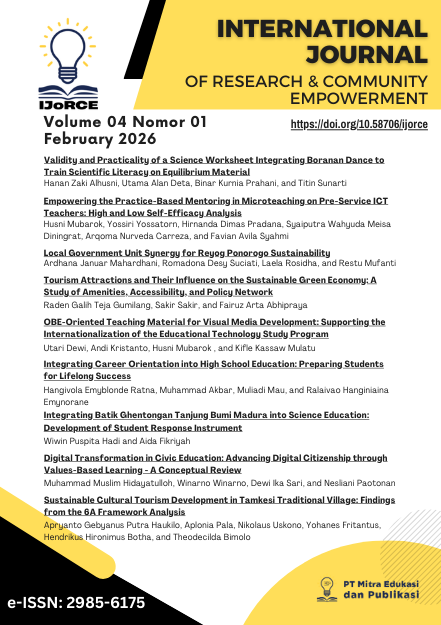
Digital Transformation in Civic Education: Advancing Digital Citizenship through Values-Based Learning - A Conceptual Review
DOI:
https://doi.org/10.58706/ijorce.v4n1.p72-81Keywords:
Digital Transformation, Civic Education, Digital Citizenship, Values-based Learning, Quality EducationAbstract
The fast growth of digital technology has changed how education works, including Civic Education, which helps make citizens responsible and involved in society. In today’s digital world, Civic Education has to not only use technology in teaching but also make sure that using digital tools is based on knowing what’s right, being responsible, and supporting democracy. This study looks at how changing to digital teaching methods in Civic Education can help students become better digital citizens by using a learning approach that focuses on values. The study uses a detailed review of existing research and ideas to gather information from articles, government policies, and real-world studies about digital change, civic education, digital citizenship, and teaching values. The research shows that using digital teaching methods like blended learning, flipped classrooms, project-based learning, and interactive digital tools can help students improve their civic skills, their ability to think critically about digital content, and their sense of responsibility online. It also shows that learning based on values helps students handle problems like fake news, divided opinions online, and shallow engagement with digital content. This study highlights the need for teachers to act as guides who encourage thinking and active learning, connecting civic values with digital activities. The ideas from this study help build better Civic Education programs that support digital citizenship and provide high-quality education, which connects to important goals like improving education (Goal 4), promoting peace and justice (Goal 16), and reducing inequality (Goal 10).
References
Afriadi, B. (2024). The role of citizenship education in shaping awareness of democracy and political participation in the digital era. International Journal of Business, Law, and Education, 5(2), 2918-2924. DOI: https://doi.org/10.56442/ijble.v5i2.1039.
Agus, A.A., Rizal, A., Muhajir, M., & Jamalong, A. (2025). From awareness to action: rethinking high school civic education for the digital generation in Indonesia. Cogent Education, 12(1), 2534156. DOI: https://doi.org/10.1080/2331186X.2025.2534156.
Alainati, S., & Al-Hunaiyyan, A. (2024). The role of educational systems in developing the twenty-first century skills: perspectives and initiatives of gulf cooperation council countries. Journal of Research Administration, 6(1), 1252-1277. Retrieved from: https://journlra.org/index.php/jra/article/view/1255.
Allouche, E. (2024). Digital transformation of education, systems approach and applied research. ArXiv. DOI: https://doi.org/10.48550/arXiv.2406.11861.
Azis, A., Maftuhin, M., & Nugraha, D.M. (2021). Citizenship education in the Covid-19 era: How to become a digital citizen? Jurnal Civics: Media Kajian Kewarganegaraan, 18(2), 207–216. DOI: https://doi.org/10.21831/jc.v18i2.40833.
Azis, U.A. & Ahmad, M. (2022). Analysis of the effect of online-based interactive digital learning media Word Wall on Pancasila and Citizenship Education learning outcomes of elementary school students. Jurnal Paedagogy, 9(3), 609-615. DOI: https://doi.org/10.33394/jp.v9i3.5344.
Bowyer, B. & Kahne, J. (2020). The digital dimensions of civic education: Assessing the effects of learning opportunities. Journal of Applied Developmental Psychology, 69, 101162. DOI: https://doi.org/10.1016/j.appdev.2020.101162.
Candra, A.A., Suryadi, K., Rahmat, R., & Nurbayani, S. (2021). Digital citizenship infrastructure to foster the reinforcement of national identity in Indonesia. Kultura-Społeczeństwo-Edukacja, 19(1), 37–50. DOI: https://doi.org/10.14746/KSE.2021.19.3
Carmi, E., Yates, S. J., Lockley, E., & Pawluczuk, A. (2020). Data citizenship: Rethinking data literacy in the age of disinformation, misinformation, and malinformation. Internet Policy Review, 9(2), 1481. DOI: https://doi.org/10.14763/2020.2.1481.
Chen, H. & Huang, Y. (2024). The impact of digital learning platforms on student motivation in high school. Journal of Education, Humanities and Social Sciences, 39, 391–395. DOI: https://doi.org/10.54097/fab4wb46
Dash, B.B. (2022). Digital tools for teaching and learning english language in 21st century. International Journal of English and Studies, 4(2), 8-13. Retrieved from: https://www.ijoes.in/papers/v4i2/2.IJOES-Dr.Bipin(8-13).pdf.
Elsayed, H., Bradley, L., Lundin, M., & Nivala, M. (2023). Social and democratic values in school based health promotion: A critical policy analysis. Cogent Education, 10(2), 2259477. DOI: https://doi.org/10.1080/2331186X.2023.2259477.
Fitzgerald, J.C., Cohen, A.K., Castro, E.M., & Pope, A. (2021). A systematic review of the last decade of civic education research in the United States. Peabody Journal of Education, 96(3), 235–246. DOI: https://doi.org/10.1080/0161956X.2021.1942703.
Furbani, W., Purnawanti, F., Dewi, A. E. R., Sari, N., & Thoriq, T. (2025). Digital literacy and critical thinking skills of students in the era Industry 4.0. Juwara: Jurnal Wawasan dan Aksara, 5(1), 136–148. DOI: https://doi.org/10.58740/juwara.v5i1.382.
Gani, A.A. & Saddam, S. (2020). Pembelajaran interaktif pendidikan kewarganegaraan melalui mobile learning di era industri 4.0. CIVICUS: Pendidikan-Penelitian-Pengabdian Pendidikan Pancasila dan Kewarganegaraan, 8(1), 36-42. DOI: https://doi.org/10.31764/civicus.v8i1.1849.
Hava, K. & Gelibolu, M. F. (2018). The impact of digital citizenship instruction through flipped classroom model on various variables. Contemporary Educational Technology, 9(4), 390–404. DOI: https://doi.org/10.30935/cet.471013.
Hermawan, D., Darmawan, C., & Bestari, P. (2024). Transforming citizenship education in the digital era: challenges and opportunitiesfor the Indonesian millennial generation. Unnes Political Science Journal, 8(1), 30–38. DOI: https://doi.org/10.15294/upsj.v8i1.5783.
Johannesen, M., grim, L., & Hatlevik, O. E. (2024). Teachers’ professional digital competence – The neglected management of technology-rich classrooms? Nordic Journal of Digital Literacy, 19(2), 64–81. https://doi.org/10.18261/njdl.19.2.2
Katara. (2023). Twenty-first century skills: Educational best practices for education. Cultural Village Foundation, Doha, Qatar: Katara.
Lee, A. (2021). Civility and its discontents: Subway etiquette, civic values, and political subjectivity in global Taiwan. Mobilities, 16(4), 476–492. DOI: https://doi.org/10.1080/17450101.2021.1919492.
Li, L., Valdez, J.P.M., & Du, Y. (2025). Digital citizenship education at the early childhood level: how is it implemented? A systematic review. International Journal of Child Care and Education Policy, 19, 13. DOI: https://doi.org/10.1186/S40723-025-00153-2.
Lumbantobing, M.T., Samosir, A., & Tarigan, D.R.B. (2020). Tantangan pembelajaran daring selama pandemi Covid-19. EJoES (Educational Journal of Elementary School), 1(2), 33–36. DOI: https://doi.org/10.30596/ejoes.v1i2.7187.
Mackey, T.P. & Jacobson, T.E. (2021). Metaliteracy and the perspectives of information science in the digital age. University Libraries Faculty Scholarship. 165. Retrieved from: https://scholarsarchive.library.albany.edu/ulib_fac_scholar/165.
Mansour, N. (2024). Students’ and facilitators’ experiences with synchronous and asynchronous online dialogic discussions and e-facilitation in understanding the nature of science. Education and Information Technologies, 29(12), 15965–15997. DOI: https://doi.org/10.1007/S10639-024-12473-W.
Pérez-Juárez, M.Á., González-Ortega, D., & Aguiar-Pérez, J.M. (2024). Digital distractions from the point of view of higher education students. Sustainability (Switzerland), 15(7), 6044. DOI: https://doi.org/10.3390/su15076044.
Phuong, T.T.T., Nguyen, T.T., Danh, N.N., Van, D.N., Luong, H.D., Nguyen, L.V.A., & Tran, T. (2023). Digital transformation in education: A bibliometric analysis using Scopus. European Science Editing, 49, e107138. DOI: https://doi.org/10.3897/ese.2023.e107138.
Prasetiyo, W.H., Sumardjoko, B., Muhibbin, A., Naidu, N.B.M., & Muthali’in, A. (2023). Promoting digital citizenship among student-teachers: The role of project-based learning in improving appropriate online behaviors. Participatory Educational Research, 10(1), 389–407. DOI: https://doi.org/10.17275/per.23.21.10.1.
Putri, A.K., Rahmawati, D.E., & Zainudin, A. (2025). Digital citizenship in the 21st century: Strengthening digital ethics. CosmoGov: Jurnal Ilmu Pemerintahan, 11(1), 92–109. DOI: https://doi.org/10.24198/cosmogov.v11i1.60821.
Rediani, N.N., Palittin, I.D., & Kaize, B.R. (2024). Project based learning: Enhancing character and creative thinking skills through activity-based projects in numeracy literacy courses. Indonesian Values and Character Education Journal, 7(1), 88–100. DOI: https://doi.org/10.23887/ivcej.v7i1.80139.
Safitri, W.Y., Ananda, A., Suryanef, S., & Putra, I. (2023). Pembelajaran daring dan permasalahannya pada mata pelajaran PPKn. Journal of Education, Cultural and Politics, 3(1), 179–185. DOI: https://doi.org/10.24036/jecco.v3i1.27.
Sari, G., Winasis, S., Pratiwi, I., Nuryanto, U.W., & Basrowi. (2024). Strengthening digital literacy in Indonesia: Collaboration, innovation, and sustainability education. Social Sciences & Humanities Open, 10, 101100. DOI: https://doi.org/10.1016/j.ssaho.2024.101100.
Sarkawi, D., Oktaviani, A., Priadi, A., & Nurhidayati. (2025). The impact of digital literacy in shaping civic awareness among the younger generation on social media platforms. Journal of Basic and Applied Research International, 31(5), 207–217. DOI: https://doi.org/10.56557/jobari/2025/v31i59854.
Sugiarto, & Farid, A. (2023). Literasi digital sebagai jalan penguatan pendidikan karakter di era Society 5.0. Cetta: Jurnal Ilmu Pendidikan, 6(3), 580–597. DOI: https://doi.org/10.37329/cetta.v6i3.2603.
Tirza, J., Tambunan, A., Parwati, N.N., & Cendana, W. (2025). Enhancing active citizenship: Developing assessment tools for digital literacy and critical thinking in Indonesian Civics Education. REID (Research and Evaluation in Education), 11(1), 75–88. DOI: https://doi.org/10.21831/reid.v11i1.83859.
Vallès-Peris, N., & Domènech, M. (2024). Digital citizenship at school: Democracy, pragmatism and RRI. Technology in Society, 76, 102448. DOI: https://doi.org/10.1016/j.techsoc.2023.102448.
Witek, D. & Grettano, T. (2014). Teaching metaliteracy: A new paradigm in action. Reference Services Review, 42(2), 188–208. DOI: https://doi.org/10.1108/RSR-07-2013-0035.
Yulin, N. & Danso, S. D. (2025). Assessing pedagogical readiness for digital innovation: A mixed-methods study. ArXiv. DOI: https://doi.org/10.48550/arXiv.2502.15781.
Zhang, W., Chen, Z., Chia, Y.T., & Neoh, J.Y. (2022). Rethinking civic education in the digital era: How media, school, and youth negotiate the meaning of citizenship. International Communication Gazette, 84(4), 287–305. DOI: https://doi.org/10.1177/17480485221094101.
Zheng, Y., Zhang, J., Li, Y., Wu, X., Ding, R., Luo, X., Liu, P., & Huang, J. (2024). Effects of digital game-based learning on students’ digital etiquette literacy, learning motivations, and engagement. Heliyon, 10(1), e23490. DOI: https://doi.org/10.1016/j.heliyon.2023.e23490.
Downloads
Statistics
Additional Files
Published
How to Cite
Issue
Section
License
Copyright (c) 2025 Muhammad Muslim Hidayatulloh, Winarno Winarno, Dewi Ika Sari, Nesliani Paotonan

This work is licensed under a Creative Commons Attribution-NonCommercial 4.0 International License.