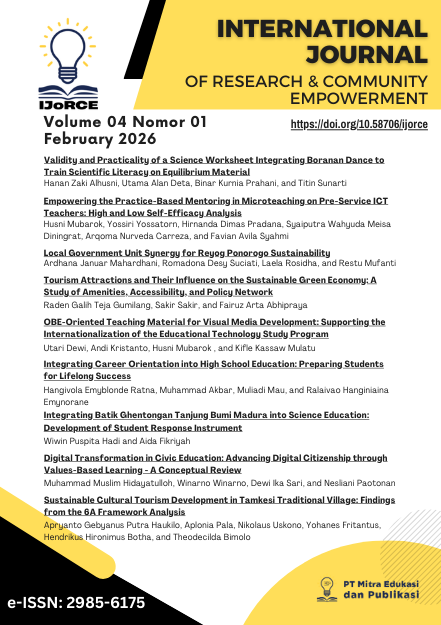
Tourism Attractions and Their Influence on the Sustainable Green Economy: A Study of Amenities, Accessibility, and Policy Network
DOI:
https://doi.org/10.58706/ijorce.v4n1.p31-41Keywords:
Green Economy, Senaru Village, Tourism Attractive, SustainableAbstract
Tourism villages play a crucial role in promoting sustainable regional development by integrating environmental preservation with local economic empowerment. In this context, Senaru Tourism Village represents a model of how natural and cultural attractions can contribute to a sustainable green economy. The purpose of this study is to find out the Influence of Senaru Village Tourism Attraction on the Sustainable Green Economy. The research method used was quantitative, with the primary data source being a questionnaire of 200 respondents (domestic and foreign tourists). The selection of Senaru Tourism Village with a policy network approach, the development of Senaru Village is no longer only oriented towards increasing the number of tourist visits, but shifting towards fulfilling overall welfare or destination tourism wellbeing (DTW). Measurement is carried out using variables from the tourist attraction framework consisting of amenities, attractions, accessibility, and other supporting factors. The research method used was quantitative, with the primary data source being a questionnaire of 200 respondents (domestic and foreign tourists). Data analysis using SEM-pls software was used in conducting data analysis for this study. Data presentation used the results of hypothesis tests, Cronbach alpha, and statistical t-values. The results of the study show that three of the five variables which include amenities, accessibility, and Policy Network have an effect on the green economy. Then for the attraction and ancillary variables have no effect on the green economy.
References
Amir, A., Sukarno, T.D., & Rahmawati, F. (2020). Identifikasi potensi dan status pengembangan desa wisata di Kabupaten Lombok Tengah, Nusa Tenggara Barat. Journal of Regional and Rural Development Planning, 4(2), 84–98. DOI: https://doi.org/10.29244/jp2wd.2020.4.2.84-98.
Anam, Y.C., Lubis, D.A., & Miranti, R.C. (2025). The role of industrial, agricultural, and household economic activities in the formation of a green economy in East Java: Determinants from a spatial perspective. East Java Economic Journal, 9(1), 134–161. DOI: https://doi.org/10.53572/ejavec.v9i1.154.
Apriani, B.S., Wibawanindah, N., Cahyani, D.N., Khotimah, K., Karlina, B.R., Andrian, L.M., Setiawan, L.A.A., Astuti, I.A., Fitri, A.M., & Ichsan, A.C. (2022). Pemanfaatan dan pengolahan sampah sebagai upaya dalam menjaga lingkungan di Desa Senaru, Kecamatan Bayan, Kabupaten Lombok Utara. Jurnal Pengabdian Magister Pendidikan IPA, 5(2), 295–299. DOI: https://doi.org/10.29303/jpmpi.v5i2.1806.
Asriady, D. (2021). Rinjani menuju pengelolaan pendakian kelas dunia yang berkelanjutan. Jakarta: DPRRI. Retrieved from: https://www.dpr.go.id/dokakd/dokumen/K4-RJ-20210917-011807-7348.pdf.
Asyrofi, I., Hilal, S. & Madnasir. (2024). Dinamika perkembangan halal tourism Provinsi Lampung: Analisis implementasi green economy. INOVASI: Jurnal Ekonomi, Keuangan dan Manajemen, 20(2), 335–344. DOI: https://doi.org/10.30872/jinv.v20i2.1782.
Awewomom, J., Dzeble, F., Takyi, Y.D., Ashie, W.B., Ettey, E.N.Y.O., Afua, P.E., Sackey, L.N.A., Opoku, F., & Akoto, O. (2024). Addressing global environmental pollution using environmental control techniques: a focus on environmental policy and preventive environmental management. Discover Environment, 2(1), 8. DOI: https://doi.org/10.1007/s44274-024-00033-5.
Badoc-Gonzales, B.P., Mandigma, M.B.S., & Tan, J.J. (2022). SME resilience as a catalyst for tourism destinations: A literature review. Journal of Global Entrepreneurship Research, 12, 23-44. DOI: https://doi.org/10.1007/s40497-022-00309-1.
Bata, G. (2023). Exploring a New Destination Image: A Case Study of Suranadi Village. Journal of Environment Management and Tourism, VII(4). https://doi.org/https://doi.org/10.14505/jemt
Boschet, C. & Rambonilaza, T. (2018). Collaborative environmental governance and transaction costs in partnerships: evidence from a social network approach to water management in France. Journal of Environmental Planning and Management, 61(1), 105–123. DOI: https://doi.org/10.1080/09640568.2017.1290589
Diogsha, H. & Noviarita, H. (2024). Implementasi konsep green economy terhadap pengelolaan taman wisata alam wira garden Kota Bandar Lampung, Sebagai upaya mewujudkan pembangunan ekonomi yang berkelanjutan. Revenue: Jurnal Ekonomi Pembangunan dan Ekonomi Islam, 7(1), 20–27. DOI: https://doi.org/10.56998/jr.v7i01.96.
Diputra, G.I.S. (2024). Penerapan green economy pada sektor pariwisata di Bali. Jurnal Ekuilnomi, 6(2), 182–193. DOI: https://doi.org/10.36985/mbb4n278.
Ermelia, T., Imsar, I., & Harahap, R.D. (2023). Analisis konsep green economy terhadap potensi pengembangan pariwisata halal di Sumatera Utara. Jurnal Proaksi, 10(2), 226–245. DOI: https://doi.org/10.32534/jpk.v10i2.4049.
Fauzi, E. & Rahmawati, D.E. (2019). Government of Yogyakarta City communication in the arrangement of Maliboro Areas in 2015-2016. Proceeding of IcoSIHESS, 281-283. DOI: https://doi.org/10.2991/icosihess-19.2019.48.
Genaro, A., Pratoma, D., Saefurrohma, G.U., Devi, Y., & Bahrudin, M. (2025). Implementasi green economy pada sektor pariwisata yang berpotensi sustainable di Kota Bandar Lampung ditinjau ekonomi islam. Lan Tabur: Jurnal Ekonomi Syari’ah, 6(2), 174–186. DOI: https://doi.org/10.53515/lantabur.2025.6.2.174-186.
Gracias, J.S., Parnell, G.S., Specking, E., & Pohl, E.A. (2023). Smart cities — A structured literature review. Smart Cities, 6(4), 1719–1743. DOI: https://doi.org/10.3390/smartcities6040080.
Hadipranata, Q.A.C. & Setyowati, H. (2023). Penerapan green economy dalam konsep gandeng-gendong di Kampung Wisata Rejowinangun, Yogyakarta. Jurnal Riset Manajemen Sekolah Tinggi Ilmu Ekonomi Widya Wiwaha Program Magister Manajemen, 10(1), 76-91. DOI: https://doi.org/10.32477/jrm.v10i1.598.
Hadiyana, E. (2020). Strategi humas Balai Taman Nasional Gunung Rinjani dalam memulihkan wisata pendakian Gunung Rinjani pasca gempa Lombok. Undergraduate Thesis. Mataram: UIN Mataram. Retrieved from: http://etheses.uinmataram.ac.id/1943/1/Endang Hadiyana 170301021.pdf.
Ijatuyi, E.J., Yessoufou, K., & Patrick, H.O. (2025). Sustainable tourism and green space: Exploring how green spaces and natural attractions contribute to local tourism economies and revenue generation in Gauteng province. Discover Sustainability, 6, 236. DOI: https://doi.org/10.1007/s43621-025-00958-8.
Ji, H. & Miao, Z. (2020). Corporate social responsibility and collaborative innovation: The role of government support. Journal of Cleaner Production, 260, 121028. DOI: https://doi.org/10.1016/j.jclepro.2020.121028.
Kajanus, M., Leban, V., Glavonjić, P., Krč, J., Nedeljković, J., Nonić, D., Nybakk, E., Posavec, S., Riedl, M., Teder, M., Wilhelmsson, E., Zālīte, Z., & Eskelinen, T. (2019). What can we learn from business models in the European forest sector: Exploring the key elements of new business model designs. Forest Policy and Economics, 99, 145–156. DOI: https://doi.org/10.1016/j.forpol.2018.04.005.
Khairunisa, T., Rachmadian, R.H., Dermawan, J., Hilmy, M.Z., & Putra, A.K. (2023). Pengembangan tourism virtual reality sebagai optimalisasi digital promotion green economy Wisata Gumuk Pangroso Poncokusumo. JURPIKAT (Jurnal Pengabdian Kepada Masyarakat), 4(3), 548–563. DOI: https://doi.org/10.37339/jurpikat.v4i3.1483.
Knapp, E. & Vandegehuchte, M.B. (2022). The tourism value of the coast: Modeling seaside amenity values in Belgium. International Journal of Hospitality & Tourism Administration, 25(1), 202–219. DOI: https://doi.org/10.1080/15256480.2022.2092248.
Koerniawan, R.N.R. & Umar, G. (2025). Kritik terhadap green economy dalam praktik pembangunan di negara. Trends in Applied Sciences, Social Sciences, and Education, 3(1), 51–70. DOI: https://doi.org/10.71383/tase.v3i1.85.
Kourtit, K., Nijkamp, P., Östh, J., & Türk, U. (2025). A digital ‘smiley’ analysis of the appreciation for tourist amenities by visitors to London. Applied Research in Quality of Life, 0123456789. DOI: https://doi.org/10.1007/s11482-025-10432-2.
Levyda, L., Ratnasari, K., & Giyatmi, G. (2021). Authentic food souvenir to support msmes and local wisdom in Bangka Belitung, Indonesia. Geojournal of Tourism and Geosites, 35(2), 531–536. DOI: https://doi.org/10.30892/GTG.35234-681.
Lew, A.A. (1987). A framework of tourist attraction research. Annals of Tourism Research, 14(4), 553–575. DOI: https://doi.org/10.1016/0160-7383(87)90071-5.
Li, C. & Zhang, Z. (2025). Collaborative development of the digital economy, tourism economy, and ecological environment to achieve green and sustainable development. Environment, Development and Sustainability, 0123456789. DOI: https://doi.org/10.1007/s10668-024-05927-1.
Liou, J.-L., Hsu, P.-C., & Wu, P.-I. (2020). The effect of China’s open-door tourism policy on Taiwan: Promoting or suppressing tourism from other countries to Taiwan? Tourism Management, 78, 104055. DOI: https://doi.org/10.1016/j.tourman.2019.104055.
Mihalic, T., Mohamadi, S., Abbasi, A., & Dávid, L.D. (2021). Mapping a sustainable and responsible tourism paradigm: A bibliometric and citation network analysis. Sustainability, 13(2), 853. DOI: https://doi.org/10.3390/su13020853.
Mistriani, N., Kuntariningsih, A., Karyadi, K., Octavian, R., Sunarko, I.H., & Aprilia, E.M. (2024). Green economy peran perempuan melalui pemanfaatan tanaman obat keluarga untuk pengembangan pariwisata berkelanjutan. JMM (Jurnal Masyarakat Mandiri), 8(6), 5978-5991. DOI: https://doi.org/10.31764/jmm.v8i6.27187.
Mondschein, A., Zhang, Z., & Khafif, M.E. (2019). Community-centered urban sensing: Smart engaged planning and design in a dysfunctional urban context. International Journal of E-Planning Research, 8(4), 1–16. DOI: https://doi.org/10.4018/IJEPR.2019100101.
Nerini, F.F., Slob, A., Engström, R.E., & Trutnevyte, E. (2019). A research and innovation agenda for zero-emission European cities. Sustainability (Switzerland), 11(6), 1692. DOI: https://doi.org/10.3390/su11061692.
Nunnally, J.C. (1978). Psychometric Theory (2nd ed.). New York: McGraw-Hill.
Nutralip, Susanty, S., Kurniansah, R., & Suteja, I.W. (2021). Strategi pengembangan Desa Wisata Senaru Lombok Utara. Journal Of Responsible Tourism, 75(17), 399–405. DOI: https://doi.org/10.47492/jrt.v1i1.992.
Panth, P. (2021). Economic Development: Definition, Scope, and Measurement In W. Leal Filho, A.M. Azul, L. Brandli, A.L. Salvia, P.G. Özuyar, & T. Wall (eds.). No Poverty. Switzerland: Springer, Cham. DOI: https://doi.org/10.1007/978-3-319-95714-2_38.
Pašalić, I.N., Ćukušić, M., & Jadrić, M. (2021). Smart city research advances in Southeast Europe. International Journal of Information Management, 58, 102127. DOI: https://doi.org/10.1016/j.ijinfomgt.2020.102127.
Pramezwary, A., Lemy, D.M., Juliana, Sitorus, N.B., Masatip, A., Dalimunthe, F.I., Liyushiana, & Yanti, D. (2022). Sustainability gastronomy tourism in Medan City. International Journal of Sustainable Development and Planning, 17(3), 875–883. DOI: https://doi.org/10.18280/ijsdp.170317.
Purwaningwulan, M.M. & Ramdan, T.D. (2022). Digital promotion of local tourist destinations in the new normal era and its effect on the economy in Indonesia. Journal of Eastern European and Central Asian Research, 9(1), 29–40. DOI: https://doi.org/10.15549/jeecar.v9i2.873.
Puteri, O.R. & Purnomo, A.S.D. (2024). Penerapan Green Economy Di Indonesia: Literature Review. Competence: Journal of Management Studies, 18(1), 98–120. DOI: https://doi.org/10.21107/kompetensi.v18i1.26522.
Putri, D.A.S., Dewandaru, B., & Rahmadi, A.N. (2024). Analisis motivasi ecopreneur dalam menciptakan green economy pada UMKM Desa Wisata Jambu Kediri. Jurnal Penelitian Manajemen Terapan (PENATARAN), 9(2), 120–129. Retrieved from: https://journal.stieken.ac.id/index.php/penataran/article/view/900.
Sakir, Pramusinto, A., Kusumasari, B., & Husein, R. (2025). Disaster-prone tourism villages into green tourism: A case study of Bantul Regency. IOP Conference Series: Earth and Environmental Science, 1489, 012032. DOI: https://doi.org/10.1088/1755-1315/1489/1/012032.
Sari, Y.R., Handayani, D.W., Marta, A., Desiana, V., & Wiranata, I.J. (2022). Penta helix collaboration on village tourism development program in Indonesia post Covid-19 pandemic. Proceedings of the Universitas Lampung International Conference on Social Sciences (ULICoSS 2021), 25–32. DOI: https://doi.org/10.2991/assehr.k.220102.004.
Shi, Y., Osewe, M., Anastacia, C., Liu, A., Wang, S., & Latif, A. (2023). Agricultural supply-side structural reform and path optimization: Evidence from China. International Journal of Environmental Research and Public Health, 20(1), 113. DOI: https://doi.org/10.3390/ijerph20010113.
Sholikin, A., Erison, Y., & Rohmah, E.N.L. (2025). Transition of extractive industry governance: Effort towards an inclusive green economy. Jurnal Sosiologi Dialektika, 20(1), 43–60. DOI: https://doi.org/10.20473/jsd.v20i1.2025.43-60.
Sigala, M. (2020). Tourism and COVID-19: Impacts and implications for advancing and resetting industry and research. Journal of Business Research, 117, 312-321. DOI: https://doi.org/10.1016/j.jbusres.2020.06.015.
Singh, P. & Helfert, M. (2019). Smart cities and associated risks: Technical v/s non-technical perspective. Proceedings of the 3rd International Conference on Computer-Human Interaction Research and Applications CHIRA, 1, 221–228. DOI: https://doi.org/10.5220/0008494402210228.
Siswoyo, H. (2017). Metode SEM untuk penelitian manajemen AMOS LISREL PLS. Jakarta: Luxima Metro Media.
Steer, R., Spours, K., Hodgson, A., Finlay, I., Coffield, F., Edward, S., & Gregson, M. (2007). ‘Modernisation’ and the role of policy levers in the learning and skills sector. Journal of Vocational Education and Training, 59(2), 175–192. DOI: https://doi.org/10.1080/13636820701342574.
Syaifudin, M.Y. & Ma’ruf, M.F. (2019). Peran pemerintah desa dalam pengembangan dan pemberdayaan masyarakat melalui desa wisata (Studi di Desa Jurug Kabupaten Ponorogo). Journal Publika, 10(2), 365-380. DOI: https://doi.org/10.26740/publika.v10n2.p365-380.
Tefera, M.W. (2024). Review on valuation of environmental amenity and pollution. Journal of Environmental Science and Economics, 3(2), 1–16. DOI: https://doi.org/10.56556/jescae.v3i2.837.
Toubes, D.R. & Araújo-Vila, N. (2022). A review research on tourism in the green economy. Economies, 10(6), 137. DOI: https://doi.org/10.3390/economies10060137.
Vu, H.D., Nguyen, A.T.N., Nguyen, N.T.P., & Tran, D.B. (2022). Impacts and restoration strategy of the tourism industry post-COVID-19 pandemic: evidence from Vietnam. Journal of Tourism Futures, 1–13. DOI: https://doi.org/10.1108/JTF-09-2021-0218.
Widiyastuti, D., Azmi, F.N., Adhitama, S.Y., Destiana, K., Dahlan, A.D., Syakbana, Z.P., Nur’aini, I., Anwar, M.S., Khairina, N.G., Nurhikmah, I., Anindita, L., & Almasari, H. (2023). Analisis tingkat perkembangan destinasi wisata Kabupaten Bantul, Daerah Istimewa Yogyakarta. COMPACT: Spatial Development Journal, 2(1), 65–78. DOI: https://doi.org/10.35718/compact.v2i1.851.
Wulida, S.N., Khosyiati, N.E., Yusuf, A., Biworo, M., & Andrian, S.H. (2024). Inovasi mesin pengolahan paving block dari sampah plastik guna mewujudkan green economy dalam SDGs 2030. Multidisciplinary Indonesian Center Journal (MICJO), 1(3), 1552–1558. DOI: https://doi.org/10.62567/micjo.v1i3.199.
Yuliantini, L.S. (2023). The impact of the e-government development index (EGDI) on the Worldwide Governance Indicator (WGI) in European Union Countries. Policy & Governance Review, 7(2), 140–153. DOI: https://doi.org/10.30589/pgr.v7i2.732.
Downloads
Statistics
Additional Files
Published
How to Cite
Issue
Section
License
Copyright (c) 2026 Raden Galih Teja Gumilang, Sakir Sakir, Fairuz Arta Abhipraya

This work is licensed under a Creative Commons Attribution-NonCommercial 4.0 International License.